
I hear this more and more often.
Someone discovers a new “curing thing”. A pill, a compound, a diet, a peptide, a plant extract. Supposedly it cures almost everything. Cancer, inflammation, depression, aging, sometimes even bad posture and bad luck.
And then comes the familiar explanation.
Doctors are hiding it.
Big pharma is blocking it.
Governments are evil.
Everyone is greedy.
Of course, there are bad people. There are bad doctors, sometimes even criminals. There are corporations that chase profit at the expense of ethics. Anyone who says otherwise is naive. But stopping the conversation there is lazy thinking. People who accept these simple explanations too easily are often influenced by a well-crafted marketing narrative rather than a real look at reality.
Let’s talk about a few uncomfortable realities.
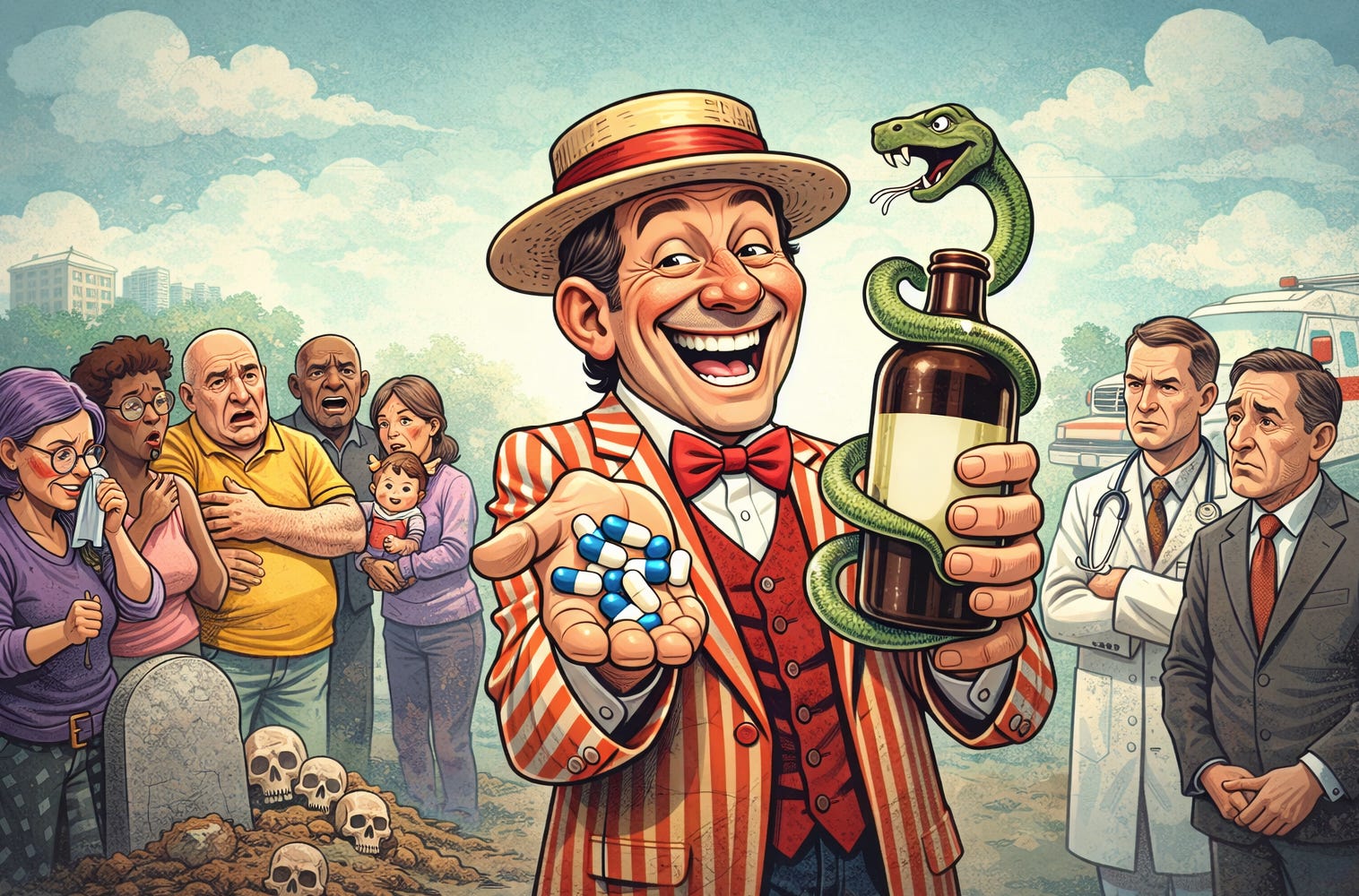
1. Yes, the healthcare system is flawed. And yes, it still saves lives.
Almost everyone I know has a story. A wrong diagnosis. A prescription that made things worse. A doctor who did not listen. Sometimes the consequences were lethal.
Healthcare systems are bureaucratic. Incentives are often broken. Mistakes happen more than they should.
And yet.
When your child has a high fever and nothing helps, you go to a doctor.
When someone has appendicitis, pills from TikTok will not help.
When a bacterial infection hits, antibiotics work. Period.
Many doctors do an excellent job. Many drugs work exactly as intended. Many companies have created treatments that radically changed human survival and quality of life. And let’s not forget that average human life expectancy was around 30–40 years at the beginning of the 20th century, and today it is over 70 years globally, more than double in just one century.
Both things can be true at the same time. A system can be flawed and still essential.
2. Living systems are not simple machines
This is the part most miracle-cure narratives ignore.
The human body is not a flashlight where you change a battery and everything works again.
Each cell is a factory. Each system is interconnected. Hormones, immune responses, microbiome, genetics, environment, stress, sleep, nutrition. Everything affects everything.
A substance that helps one pathway can harm another.
A dose that helps one person can hurt another.
Short-term improvement can hide long-term damage.
Biology is messy. Nuanced. Probabilistic.
The idea that one tablet can “fix everything” is not optimistic. It is scientifically childish.
If something truly cured everything, it would not be hidden. It would be impossible to hide. And of course there are always new things that are mostly not yet accepted, and sometimes they become something real and useful.
3. Reading an article does not make you an expert
We live in a time where access to information is confused with understanding.
Someone reads three blog posts, watches a podcast, and suddenly knows more than people who spent decades studying a field, especially when it comes to the human body and living organisms.
Science does not work like that.
Most scientific questions do not have final answers. They have current best explanations. These evolve. They get refined. Sometimes they get replaced.
That does not make science weak. It is just what it is, and it is real.
Certainty is usually a red flag. Especially when it comes with a product link.
4. We have seen this cycle before, many times
This is not new.
Years ago, cholesterol was the enemy. Fat was bad. Eggs were dangerous. Butter or meat was almost treated like poison.
Then the narrative shifted. Sugar became the villain, even though hundreds of years ago it was saving lives from hunger. Then carbs. Then gluten. Suddenly gluten was the root of everything, even for people without celiac disease.
Later it was seed oils. Then lectins. Then oxalates. Then histamines. Now it is peptides, compounds, injections, protocols.
Each wave follows the same pattern.
A complex problem is reduced to one cause.
A single fix is promoted as universal.
Dissent is framed as corruption or ignorance.
Sometimes these trends contain a grain of truth, blown up by marketing. Often they help a subset of people. Almost never are they universal.
Human biology did not suddenly change every five years. The story did.
5. “Natural” does not mean safe, and “synthetic” does not mean dangerous
One of the most common tricks in miracle-cure narratives is language.
“Natural” is framed as good.
“Chemical” or “synthetic” is framed as bad.
This is marketing, not biology.
Arsenic and sulfides are natural. So is cyanide.
Insulin is manufactured. So are vaccines.
What matters is not where a substance comes from, but how it interacts with the body, at what dose, for how long, and in which context.
Nature does not optimize for human safety. It optimizes for survival.
6. Correlation feels convincing. Causation is hard.
Another reason miracle cures spread so fast is personal stories.
“I took X and I felt better.”
“My inflammation disappeared.”
“My friend reversed everything.”
These experiences feel real because they are real to the person experiencing them.
I always remember my medical university years, when one of my professors used to say, “I believe it happened after taking that, but prove to me that it was because of that.”
Symptoms fluctuate. Placebo effects are powerful and measurable. Lifestyle changes often happen alongside the “cure” and get ignored.
Science tries to separate coincidence from cause. That process is slow and boring.
Stories are fast and emotionally satisfying. That is why they dominate the internet.
7. If something works, it eventually gets adopted
There is a belief that effective treatments are always suppressed forever.
History does not support this.
Treatments that work eventually spread because doctors want better outcomes, researchers want recognition, and companies want profit.
That alignment is imperfect, but it exists.
This is why antibiotics exist.
This is why insulin exists.
This is why anesthesia exists.
Suppression narratives assume a level of global coordination that simply does not exist.
8. The internet rewards certainty, not accuracy
Online platforms reward confidence, not precision.
A video titled “This might help some people under specific conditions” will not go viral.
“This cures everything they don’t want you to know” will.
Algorithms amplify emotional certainty. Fear, anger, and outrage travel faster than careful explanation.
Over time, nuance loses.
9. Wanting simple answers is human
People are not stupid for wanting simple solutions.
Chronic illness is exhausting. The healthcare system can feel cold and transactional. Many people feel unheard.
A single cure offers comfort. It creates villains and heroes. It restores a sense of control. What rarely gets discussed are the lives lost or the conditions made worse when people fully commit to these “single cure” campaigns and delay or abandon real treatment.
That emotional need deserves empathy.
But empathy should not turn into blind acceptance.
10. Science is not truth. It is a process.
This mistake is not limited to health.
When AI tools appeared, many people treated their answers as absolute truth. Final. Non-discussable.
But AI does not produce truth. It produces likely answers based on existing and popular data.
Science works the same way. Models evolve. Theories change. Knowledge expands.
Anyone selling certainty is not educating you. They are selling relief from uncertainty.
And uncertainty is part of reality.