Yesterday was my birthday. I do not do much with birthdays, but one year is a reasonable time for checking whether you still think what you thought.
So I read back through everything I wrote since last August and looked for what held up. What I still believe after saying it in public and getting hit for it.
Nobody predicts what does not exist yet
Two hundred years ago the serious prediction was mass starvation. The math held up. Fertilizer, crop genetics and modern logistics were not invented yet, so they could not be in the calculation.
In the fifties nuclear power was going to make electricity too cheap to meter. In the late nineties respected economists were saying the internet would matter about as much as the fax machine.
Nobody was stupid. They took the present and drew a straight line forward.
The AI predictions have the same shape. End of work by 2030. End of humanity by 2050. The confidence is the tell.
China is the case I keep thinking about. They believed the population forecast enough to build law on it, ran the one-child policy for decades, and it worked. Fertility is now far below the 2.1 needed to hold a population steady. The country that feared too many people is now planning for too few. The prediction did not just fail. Acting on it created the opposite problem.
I stopped trying to be right about the future. I try to stay able to move when it shows up.
The bottleneck moved and most people are optimizing the old one
Execution used to be the wall. You had an idea, then you needed people, time and money. Now one person can write, design, code, research and ship in a day or week. The tools are not perfect, but they are more than enough.
What is left is deciding. What to do, what to ignore, what to kill.
Meanwhile everyone is still buying execution capacity for a problem they no longer have. Faster call centers instead of removing the need to call. AI answering emails instead of removing the bug. Automation gives you leverage when it removes the step. It gives you noise when it decorates it.
AI does not create character, it amplifies it
I wrote about this three times and got the most heat for it.
If a developer did not read the spec before AI, they still do not read it. They just ship the slop faster. If someone owned their mistakes before, they still do. The tool moved the ceiling, not the person.
Most of the loud criticism about AI mistakes comes from people who never had to be responsible for someone else’s work. Every person I ever hired got something wrong and not once, including me of course, then got something else wrong I had not planned for. The difference between good and bad was never the error count. It was who admitted it and adjusted.
None of that means the tools are magic. Ask ChatGPT to generate an image of a left-handed boy writing with his left hand. You get a right hand almost every time, whatever words you use. Almost everyone in the training images is right-handed, so that is what comes back out. A model can pass a bar exam and fail at something a five year old gets right, because it never really understand it. Although I know adults who still mix up left and right, but that is another story :)
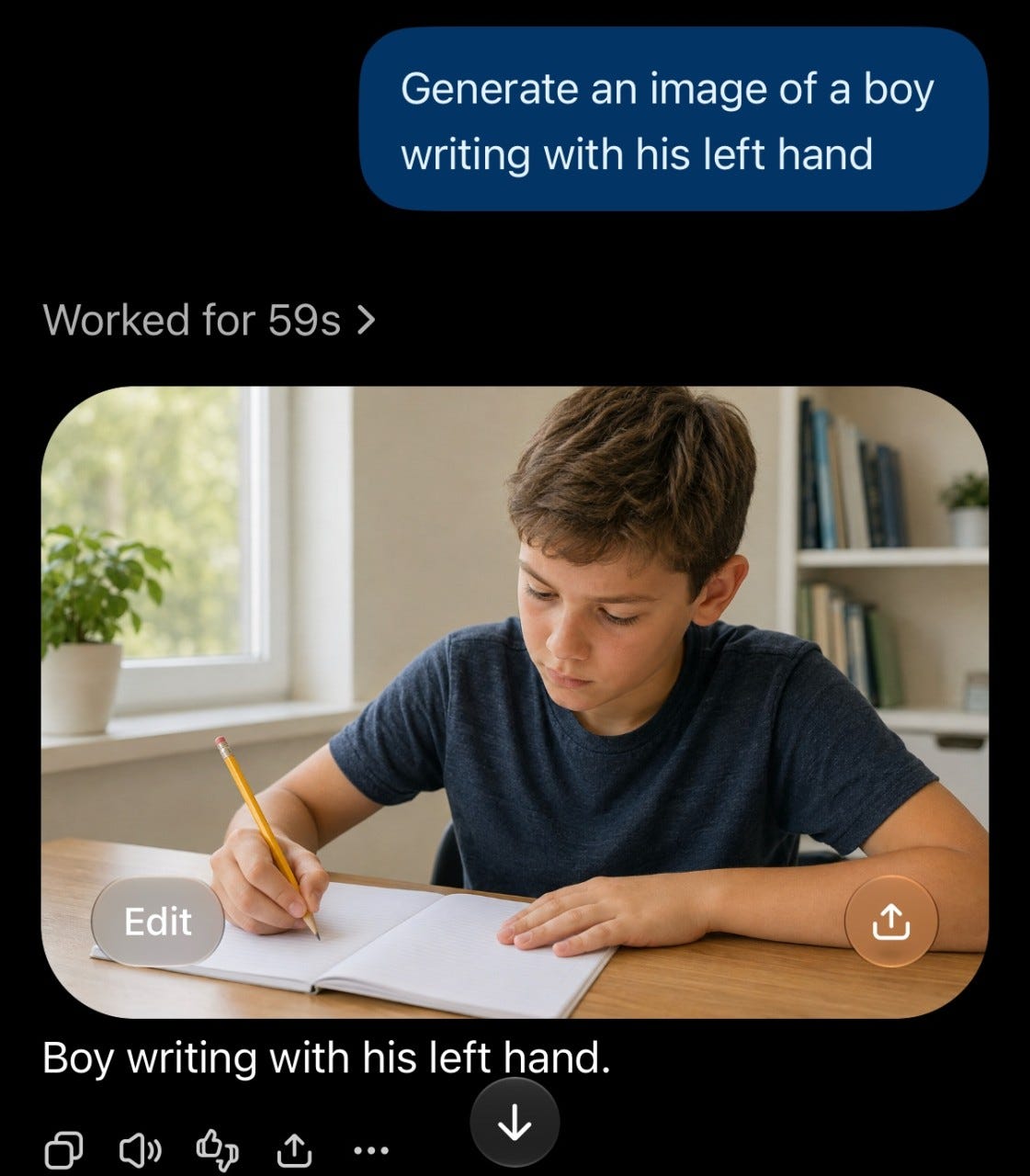
Both things are true at the same time, which is exactly why the accountability sits with whoever is holding the tool. That was the whole argument.
Most people argue with the headline
After that piece the replies came fast. One person said they skimmed it, then gave a firm opinion on what it said. Another announced AI has no right to exist. A third called it dangerous without naming one line from it.
Most read the title, some the subtitle, a few the first paragraph, then go argue in the comments.
I am not complaining, that is the environment. It taught me the title has to carry the real claim, because for most people the title is the whole article. And the ones who read to the end are worth more than the ones who reply.
Your data is not the edge
People kept asking me the same thing after Second Brain (brain.hexact.io) launched. If AI absorbs everything, how long before it absorbs your data?
It already does. That was never where the advantage was.
A fixed dataset stops being an edge the second you upload it. Same file, same model, same answer for anyone. But nothing that matters in a business is fixed. Your pipeline moves. Customers change. Numbers update with every transaction. A three-month-old snapshot of your company is history, not intelligence.
The edge is the current state and the way you connect things nobody else connects. All scientific data is public decades and only some people invent with it.
That is why I built Second Brain the way I did. Not to hide anything from AI. To give it the real current picture instead of fragments guessed from a dozen tools that never talk to each other.
Health: I stopped looking for new information
Calories decide weight. Strength training decides how well you live in your seventies, because losing muscle is what takes away independence. Protein, sleep, consistency. That is the whole list.
Understanding it was never hard. Doing it for years while nothing visible happens for months is the hard part.
The rest is noise sold as a secret. Same as the one cure or superfood story. Bad doctors exist. Broken incentives exist. Antibiotics still work, appendicitis still needs surgery, and life expectancy did not double by accident. Both things are true at once.
The questions that do not close
The piece I liked writing most was the one comparing religion and the simulation hypothesis, and it is the one I am least sure about.
Once you see the pattern you cannot unsee it. A creator or ordering intelligence. A rule set with consequences. Something of you continuing after shutdown. Channels for signaling out and sometimes getting something back. The same skeleton in traditions that never met.
I have no conclusion. I have a preference for patterns over specifics and I am fine not resolving it.
What still bothers me
I spend a lot of time saying the panic about work is overdone, because every previous shift ended fine. It did end fine on average. It was still brutal for the specific people standing in it. The weavers did not become machine operators. Their children did. So the real question is not whether work adapts. It is whether it adapts inside one person’s working life, and I do not know the answer to that.
I argued the bottleneck moved from execution to judgment. That is what people said about every layer right before it got automated. Craft, then process, then execution, each one called irreplaceable until it was replaced. I have no strong reason to believe judgment is the exception, beyond the fact that it is the ground I am currently standing on.
On health I wrote that the basics are simple and settled. People were just as sure that dietary fat was the main problem, and that advice ran for about thirty years before it was corrected. What I trust now is anything with a clear mechanism plus decades of outcome data. That filter is better than most. It would still have passed the fat advice in 1985.
What is actually left
If you cannot predict the future, and you cannot control what technology does to your industry, or which prediction some government decides to act on, then most of what people worry about is outside their hands anyway.
What is left is still huge and it is yours. How you spend the hours. Who you spend them with. Whether the work means something to you beyond the money. Whether you keep your body working long enough to enjoy the years you get. Whether the people close to you would say you were present.
That is the only remaining choice for an individual. Not predicting the future. Not preparing for a version of it that nobody can describe yet. Just figuring out how to live a life that means something in the time you have.
Everything else is commentary.