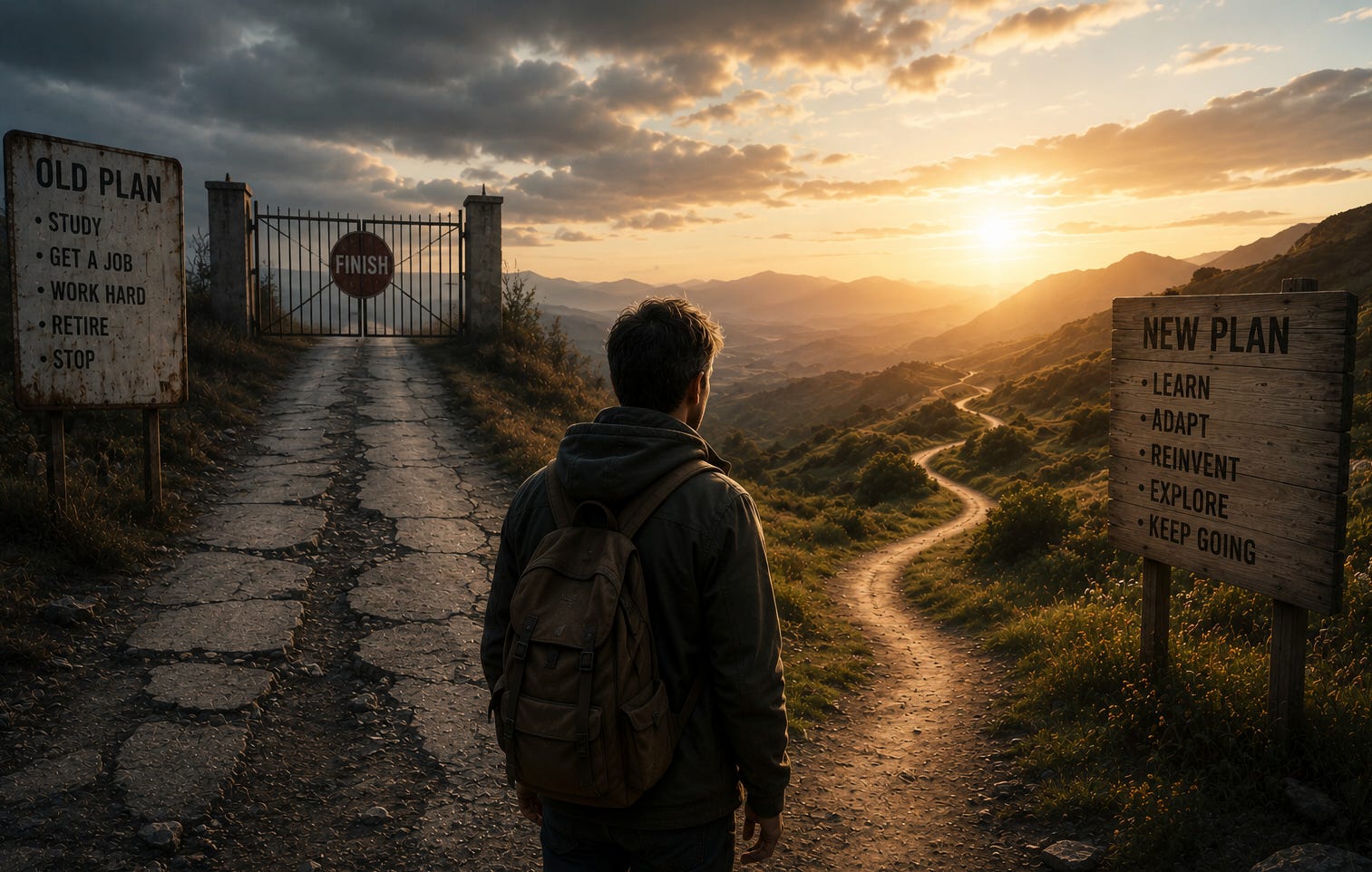
My teenage daughter asked what she should study in college, something that would still be worth it years from now. I started answering, then stopped. I do not have a clean answer for myself either.
We were both asking the wrong thing. The question assumes you can pick something that stays useful for years. You cannot, not anymore. Everything moves too fast for that now. What matters is not picking the thing that lasts. It is learning what matters now, and becoming fast enough to learn again when it changes. This is not a question you settle once and shelve. It comes back, again and again, for anyone still going. Me included.
These are my thoughts, not the last word
One note before I go on. Everything here is how I see it, not gospel. I have been wrong plenty, and my opinions have shifted more than once. The core holds. Everything around it keeps moving.
There is endless noise right now. The SpaceX IPO, the next AI model, who replaces whom, which job dies first. I have written about most of that already, whether AI ends us, why you should not trust it blindly. Scroll down through the older posts if you want those arguments. I will not repeat them here. The thing I keep circling back to is quieter, and it runs deeper than a teenager picking a major.
Nobody Is Finished Anymore
Technology and medicine are moving together now, and fast. What if that healthy lifespan stretches by half in our lifetime, maybe more. Not extra years parked in a hospital bed. Good years. Working years. Even adding ten, fifteen, twenty healthy working years changes everything. Sounds like science fiction until you look at what is already being tested on people. Drugs are in trials to slow aging itself. Other teams are clearing out the worn cells that make us old. Most of it may fail. Some of it will not. And it is happening now, in real people.
That quietly breaks the plan most people live by. Study in your twenties. Work until sixty-five. Then wind down. The whole thing assumes a short stretch at the end.
Now add forty years to that stretch. A career used to be one arc, maybe two. That is over. Now it comes in waves. They keep rolling in, and you ride each one as it arrives. It gets harder to run half of a hundred-year life on what you picked up by thirty.
Starting over late is not new. People have rebuilt at forty, at fifty, later. I have done it more than once. But it was usually the exception. The ones forced into it, or the stubborn few who jumped on their own. Everyone else picked a lane and stayed in it for life.
Now the exception becomes the rule. The ground shifts under everyone at once, so most of us will reinvent more than once, planned or not. It stops being a story you admire in someone else. It becomes the ordinary shape of a long life.
Here is the tell. Watch an older man ask my daughter what she wants to become. He asks it like a man who already arrived, as if the question is hers alone and his was closed years ago. It is not. He still has turns ahead, and his are the harder ones. She starts on a blank page. He has to rebuild on top of a life he already chose.
So the people who feel finished are wrong in a brand new way. The old risk was boredom at the end. The new one is going useless in the middle, while the life keeps going. Retirement was designed for shorter lives. Nobody updated the design. The lives changed anyway.
This is why my daughter’s question is everyone’s now. What do I learn next. It does not stop at twenty. It does not stop at fifty.
What learning turns into
Keep learning is old advice. Plenty of people already learn for life, so that is not the new part. The new part is direction. We used to learn in a straight line, deeper and deeper into one field that paid off for decades. That line is gone. Now you master something, the demand moves on, and you have to aim somewhere new. Then again. Then again. The flood of information is bigger than ever, and where you point it matters more than how much of it you pile up.
The way you learn changes too. Here is her real worry. If you can ask ChatGPT anything, why learn at all?
You still learn. Just not the old way.
You do not do long multiplication in your head anymore. The calculator handles that. But you still need to know what multiplication is, and you still need to feel when an answer is off. The basics are what let you catch the machine in a lie.
AI works the same way. Knowing how to ask is the smallest part. The skill that counts is judgment. Knowing what is worth knowing. Knowing when a confident answer is wrong. The tools raised the bar. They did not remove it. That is how I saw it with engineers too, in AI Is Not Replacing Developers.
So you end up needing to understand more, not less. Enough to judge what the machine hands you. That is harder than the old kind of learning.
The best time, and the trap
This is the best time in history to learn anything. The cost fell to almost nothing. A tireless tutor sits in your pocket and explains anything, at any level, as many times as you ask. It is also the best time to do more than ever. One person now does what used to take a whole team.
Here is the trap, and it is mine as much as anyone’s. I keep learning. But I burrow deeper into the same bubble. Same sources, same people who already agree with me.
The bubble does not stop me learning. It quietly decides what I think is worth learning. And the shift that matters almost always starts outside the feed I already read.
You cannot study what you do not know exists. Over a hundred-year working life, that is the real danger, and it is a quiet one. Your field can stop being the field that matters while you keep getting better at it, and you are the last to find out.
What we are building next
We keep building Second Brain. Your knowledge in one place, ready for AI to work with. I already wrote why I think your own data becomes the real edge, so I will skip that here. Right now we are adding more import formats, faster imports, cleaner data management. The boring plumbing that makes everything else possible.
The piece I care about most is still taking shape. An optional assistant that lives on top of your Second Brain.
Most agents today try to do everything and end up doing most of it badly. They are general, and general falls apart the moment the work becomes specific. I think the opposite. Not one assistant that tries to replace you, but a set of professions, each one doing a narrow job well, under your control.
The first one I started on is the one I want most myself. It finds what I do not even know I am missing, the things I would never think to look for. It watches the edge of my bubble and surfaces what I would have walked right past.
For random, open-ended work, tools like Codex or Claude already do a good job on top of your Second Brain. Today that is what they are great at. What we are building is for the other side, specific jobs that have to run again and again and quietly take some of that work off your hands.
I do not have the answer
So what did I tell my daughter.
The truth. I do not know what she should become. I do not know what I should become either, and I have a long stretch left to work it out.
But the direction I am sure about. Stop hunting for the thing that lasts. Learn what is useful now, deep enough to judge the machine, and stay ready to drop it and learn the next thing. Go past your own field while you are at it. A long life spent inside a small view is the thing to fear now, not the work.
I do not know where it lands, and that is the wrong question anyway. It is not going to land, it is going to speed up. I only know the old plan stopped working, so I am learning again.