
Longevity is one of the loudest topics on the internet right now. Every week there is another protocol and another molecule that is supposedly going to add a decade.
It is also a topic I keep ending up in conversations about. Everyone has read something different, and nobody is working from the same set of facts.
So I decided to collect the data myself, and to collect it fresh. Asking an AI model is not enough here. Their training data has a cutoff, and this field moves. Papers from this year overturn papers from two years ago.
Tech stack: Hexomatic to scrape, Second Brain to import and index, Claude to analyze.
The process
Step one. Scrape the video content.
I pulled the top longevity podcasts and videos with their full transcripts. 285 videos, total runtime 170 hours.
Huberman, Attia, Sinclair, Rhonda Patrick, Stanfield, Topol, Valter Longo, and a long tail of smaller channels.
Step two. Scrape the articles.
Then I pulled 1,074 article URLs. Peer-reviewed papers, institutional pages, clinical trial registrations, and supplement vendor blogs.
Step three. Import into Second Brain.
Both datasets went in as structured tables with full text, source URLs, dates, channel names and runtimes. That made it queryable.
Step four. Analyze with Claude, then check every claim against the source.
Twenty-seven rounds of review and fact-checking over two days. Every number opened at the journal it came from.
What the data showed
Every source was counted for which compounds it mentions.
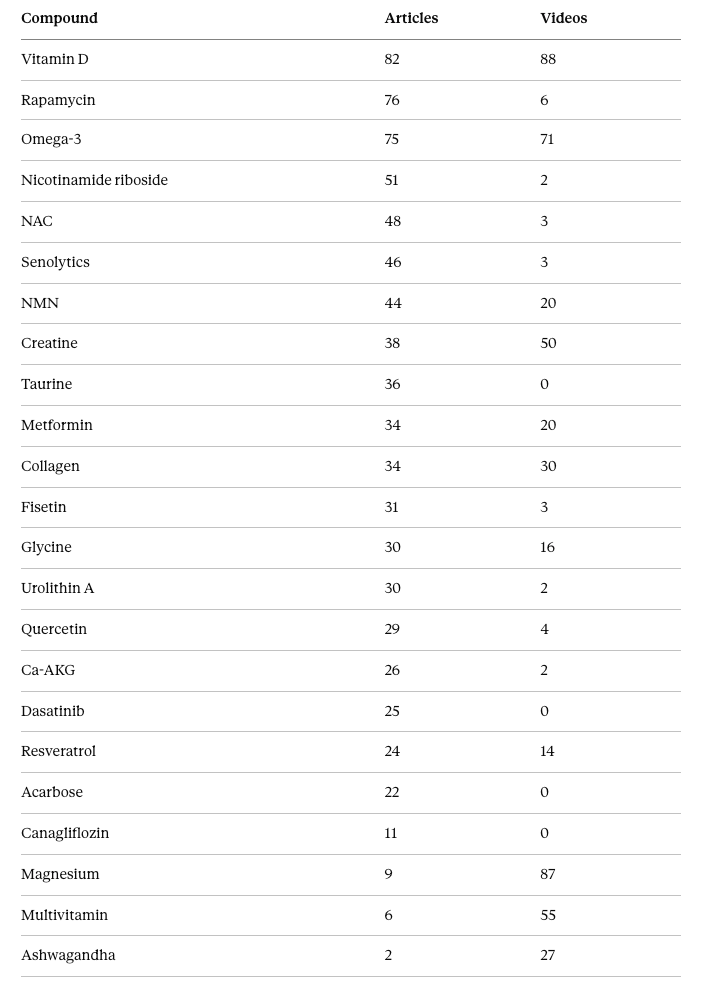
Taurine, acarbose, dasatinib and canagliflozin are researched and never discussed. Magnesium, multivitamin and ashwagandha are discussed and barely researched. The prescription drugs sit almost entirely on the article side. The supplements sit almost entirely on the video side.
The short version
No supplement in this data has been shown to slow aging. Eight things have real human evidence behind them.
Cardiovascular exercise. Dying less, of anything. Large cohorts rather than trials.
Resistance training. Strength, muscle mass, fewer falls. Trials.
Enough protein. Holding onto muscle after 50. Trials, with the target still argued over.
Creatine. Strength and lean mass. Trials. Memory, less reliably.
Omega-3. Fewer infections and falls. Trials. Fewer heart attacks, but only as a side measure.
Vitamin D, if you are deficient. Correcting deficiency. Trials. A survival signal in long trials, from subgroup analysis rather than a primary result.
A daily multivitamin. Cognition, by a small margin. Trials, not yet confirmed.
Sleep. Dying less at around seven hours. Cohorts rather than trials.
Every other supplement and drug here falls into one of four groups. It worked in mice and nowhere else. It moved a blood marker without moving an outcome. It came back mixed or negative when a trial was run in people. Or nobody has run one.
Part 1. What holds up in humans
Trials and cohorts in people, with real endpoints.
Exercise
In a study of more than 120,000 adults given treadmill tests, the unfit were several times more likely to die of any cause than the very fit, with no upper limit to the benefit. The authors put the danger of being unfit at or above smoking, diabetes, and high blood pressure.[1]
Attia and Huberman describe the same weekly structure: a few hours of easy aerobic work, one session hard enough to push VO2 max, three or four sessions of lifting.
In DO-HEALTH, a three-year trial in adults over 70, a home exercise program moved none of the four biological age tests.[2] Longevity products are commonly judged against those same measures.
Resistance training and protein
After 50, muscle mass and strength decline every year, with the lower body going roughly twice as fast as the upper. Once that loss becomes sarcopenia, fall rates in over-65s rise sharply.[3]
Two protein targets circulate. Attia argues the higher one, on the grounds that older muscle needs more protein to respond at all. The lower one comes from an analysis that found a ceiling above which extra protein added nothing. In that paper the ceiling was not statistically significant, and the uncertainty around it was wide enough to cover both targets.[4]
A Harvard and USC group looked at protein source rather than total, and found the highest intakes associated with more type 2 diabetes, entirely from animal protein. That is a cohort, not a trial.
Creatine
Creatine comes up in 50 videos and 38 articles. Combined with resistance training it beats training alone on lower-body strength and lean mass in older adults. Upper-body strength showed no significant gain. The effects are small and appear across trials.[3]
Muscle and brain need different doses, a distinction Darren Candow draws and most of the videos miss. The dose that saturates muscle is a quarter of what the memory trials used.
The main review of the memory studies drew a published letter arguing that double-counting had produced false positives.[5] A later review found effects on memory and attention but nothing on overall thinking ability.[6] Neither turned up in the videos.
Omega-3
That same trial gave its participants vitamin D, omega-3, a home exercise program, or combinations.[2] In a post hoc analysis of roughly a third of the participants, omega-3 alone slowed three of the four biological age tests, by a matter of months. Vitamin D and exercise moved nothing. Earlier results from the full trial were larger, with fewer infections and fewer falls.[2]
Four independent experts reviewed it. The omega-3 arm was small, the four tests gave different answers about the same participants, and nobody has data past three years.[7]
The largest fish oil trial in this dataset, in more than 25,000 people, set out to measure heart attack, stroke, and cardiac death together, and found no significant reduction. Heart attack counted on its own, which was a side measure, did come down.[8] Brad Stanfield quotes the second result without the first.
Vitamin D, if you are deficient
Three large trials, tens of thousands of people. In adults who already had enough, supplementing prevented no cancer, no heart attacks, no falls, no diabetes, and no bone loss.[9] A review of the whole literature found a survival benefit only in people already ill with something specific.[10] A 2025 review found no effect on heart attacks or strokes.[11]
One finding points the other way. In trials that ran longer than three years, people taking vitamin D died less often. That came from subgroup analysis, and the subgroups that benefited were on modest doses, were under 80, and started out deficient.[12]
A daily multivitamin
A three-year trial in adults over 65 compared cocoa extract, a multivitamin, both, and neither. Cocoa did nothing. The multivitamin improved cognition on all three measures.[13]
In a smaller follow-up group the overall cognition result could no longer rule out zero, though memory held.[14] The figure repeated in the videos, 60 percent slower cognitive aging, comes from the trial’s own results page, which says it needs confirming.[15]
Sleep
The mortality curve bottoms around seven hours, and the penalty for sleeping too much is steeper than for sleeping too little.[16] In a large cohort wearing objective trackers, how consistent your sleep timing was predicted mortality better than how long you slept.[17]
Deep sleep declines with age and tracks with Alzheimer’s risk. The mechanism usually given, that deep sleep flushes waste out of the brain, was contradicted by a 2024 mouse study that found clearance reduced during sleep rather than increased. Objections to that study’s methods have since been published, so the question is open.[18]
Stanfield’s melatonin argument is about dose. The trial that compared three doses found the physiological one restored sleep efficiency and brought blood levels back to normal. The pharmacological dose also improved sleep, but it caused hypothermia and left melatonin elevated into the following day.[19] The dose sold in most shops is about ten times the physiological one.
Part 2. Diet, lifestyle, and markers
Not supplements. The first is heavily evidenced and rarely discussed. The rest are heavily discussed.
ApoB
ApoB-carrying particles cause heart disease. That is the European Atherosclerosis Society consensus position, drawn from genetic, epidemiological and trial evidence, and genetic studies put ApoB ahead of LDL cholesterol as the main driver.[20]
Two things follow. Lab reference ranges are population percentiles rather than risk thresholds, so a number inside the printed range tells you that you are typical, not that you are safe. And because arterial damage accumulates from early adulthood, lowering ApoB earlier should count for more than lowering it late.
ApoB carries more evidence than anything else in this section, and appears in 11 videos and 1 article.
Fasting
78 videos and 45 articles, more than any non-supplement topic except protein. The general argument is that intermittent restriction makes cells perceive adversity and switch on repair.
The guest on Nikhil Kamath’s podcast pushes back: fasting is no better than a plain calorie deficit, and the Nobel Prize was awarded for work done in single-cell yeast. The rest of the sources disagree.
Sauna, cold, fiber, diet patterns
Sauna gets 26 videos and 1 article, cold 25 and 2, fiber 63 and 22, Mediterranean diet 35 and 9. On diet the sources agree that no particular one wins and the best is whichever a person can keep doing. On the rest there is almost nothing to check against.
Part 3. Works in mice, unproven in people
The National Institute on Aging funds a program that tests longevity drugs in mice, running the same protocol at three separate labs and pooling the results.[21]
Rapamycin
Rapamycin produced the largest effect the program has recorded, extending typical lifespan substantially in both sexes and still working when started in late middle age.[21]
Most of the human work has used related drugs rather than rapamycin itself. Those trials found the drugs tolerated and reported immune benefits, including a better flu vaccine response in older adults, but nothing on lifespan or healthy years.[22] It is a prescription immunosuppressant.
The other drugs that worked
None of the 285 videos mentions acarbose or canagliflozin, though both extended mouse lifespan by more than any supplement the videos discuss. Acarbose extends male lifespan more than rapamycin does, and does much less for females. 17-alpha estradiol and canagliflozin work in males and not females. Glycine works in both. Seven others work in males only.[21][23]
Of the compounds the program has shown to extend lifespan, most work only in males. Not one works only in females.[21]
Calcium alpha-ketoglutarate
Extended lifespan in middle-aged female mice and improved health in both sexes, with no significant side effects on long-term dosing.[24] The lifespan effect was modest and appeared in one sex only. The human study behind the marketing was not randomized and used a biological age test that has not been validated.
Part 4. Tried in people, came back mixed
Urolithin A
The pivotal trial reported stronger hamstrings and lower inflammation, with grip and quadriceps strength moving but not significantly. It missed the main thing it set out to measure. The corresponding author works at the company that sells it.[25] A later review adds that not everyone carries the gut bacteria needed to produce the compound.[26]
GlyNAC
A trial at Baylor gave twelve older adults GlyNAC and twelve a placebo for sixteen weeks. Antioxidant levels rose, damage markers fell, and walking speed improved.[27]
Nestlé then ran it in nearly ten times as many people and missed the main thing it set out to measure, except in one subgroup picked out after the fact.[28]
NAD boosters: NR and NMN
Both roughly double NAD levels in the blood, and neither beats the other. They work indirectly, through gut bacteria.[28] Short-term trials in older adults report minimal change in thinking, blood vessels, or muscle. Nicotinamide riboside was tested in the mouse program and did not extend lifespan.[23]
Senolytics: dasatinib plus quercetin
Senolytics are meant to clear out worn-out cells that stop dividing but never get removed.
In a trial at Mayo in postmenopausal women, markers of bone formation rose transiently and markers of bone breakdown did not move. The comparison across the whole group was not significant, and only the women who started with a high burden of those cells responded.[29]
The trial was designed with a fisetin arm too. It was dropped during COVID for recruitment and cost reasons, so there is no fisetin data.[29]
Part 5. Failed
Resveratrol
The mouse program tested it at two doses and neither extended lifespan.[23] The apparent mechanism turned out to depend on the assay. Resveratrol’s activation of the target enzyme only appeared when a tagged substrate was used to detect it. GSK bought Sirtris, the company built on the compound, in 2008 and closed its Cambridge operation in 2013.
David Sinclair, who co-founded Sirtris, still takes resveratrol. He points to a result in the supplemental data of the original mouse paper. It has not been replicated.
Metformin as a longevity drug
Metformin on its own did not extend lifespan in the mouse program.[23]
Sinclair takes it daily and calls it a longevity drug, citing an analysis of diabetics on metformin who outlived a non-diabetic comparison group. That is observational data from a treated patient population.
He also argues that the widely repeated claim about metformin blunting exercise adaptation came from a small difference presented on a compressed axis.
Fisetin
The mouse program dosed it both continuously and intermittently, at doses well above what a person would take. No lifespan extension in either sex, and no statistically significant reduction in the markers for worn-out cells. Without a change in those cells, the researchers could not test the mechanism the compound is sold on.[23]
Earlier work in a different mouse strain had reported both clearance and a lifespan gain. The program did not reproduce it, and the discrepancy is unresolved.
Taurine
In 2023, Vijay Yadav’s team published in Science that taurine falls with age across humans, mice, and monkeys, and that supplemented mice lived longer.[30] Sales followed.
In 2025 the same journal published the opposite. A group at the NIH followed the same individuals over time rather than comparing young people to old, and found taurine did not fall. It rose or stayed flat, and the gap between two people of the same age was larger than any change either went through.[31][32] Their summary was that there is no need to supplement if you eat reasonably.[33][34]
Yadav has not conceded and is running a controlled trial.[35]
Collagen peptides
Stanfield says collagen reduces wrinkles by about 8 percent, citing an analysis that pooled more than twenty trials.
That analysis says more. Taken together, collagen did improve hydration, elasticity, and wrinkles. Split by who paid for the trials, those without industry funding showed no effect on any of the three, and neither did the better-designed ones. The authors conclude there is currently no clinical evidence supporting collagen for skin aging.[36]
Cocoa, aspirin, methylene blue
Cocoa extract did nothing for thinking ability over three years.[13] Aspirin extended the lives of male mice in one trial, and the result did not reproduce. Methylene blue did nothing in either sex and was dropped.[23]
Part 6. Thin or absent
Pushed hard, thinly evidenced
Magnesium. 87 videos, 9 articles. The review of insomnia studies found people fell asleep somewhat faster, with no gain in total sleep time, and its authors said the literature is not good enough to make recommendations from.[37] A 2025 review found only a handful of controlled studies, most in people without sleep problems.[38]
TMG. Stanfield takes it. It lowers a blood marker linked to Alzheimer’s, but most trials show no strength gain, and nothing here shows it prevents dementia.
Psyllium. Stanfield takes it to feed gut bacteria, with reported gains in blood sugar and cholesterol.
Sulforaphane. Rhonda Patrick takes it to raise the body’s main antioxidant, and says the detoxification part is inferred rather than demonstrated.
Hormone replacement therapy. Argued in one review as something that slows aging rather than only relieving symptoms, with reported benefits and reported risks on both sides. This dataset contains one review and nothing else.
Barely there at all
CDP-choline. One mention, and it is a sidebar link on a nootropics vendor’s blog rather than an article about the compound.
Alpha-GPC. Three mentions, all about focus rather than aging. No lifespan or aging data.
Berberine. 10 videos, 4 articles. Promoted as the poor man’s metformin, on the strength of rodent work. No human longevity trial.
Tongkat ali and fadogia. 5 videos, taken for testosterone, with the reported effect described as subtle rather than significant.
Ashwagandha. 27 videos, 2 articles, used for sleep. No aging or lifespan data.
Spermidine. 14 articles, 4 videos, no human trial detail.
L-theanine. 2 articles, 10 videos, paired with caffeine rather than with aging in every mention analyzed.
Rhodiola. 1 article, 2 videos, nothing substantive.
Part 7. Three more claims that do not hold
“Your biological age test tells you how old you really are.” Eric Topol’s position: DNA methylation is the one approach with serious validation behind it, and many tests sold to consumers have not been validated. The company selling you the test also has an interest in the answer it gives you.
“You need eight hours of sleep.” Also contested by Topol. The curve bottoms around seven, and the penalty for oversleeping is steeper than for undersleeping.[16] How regular your sleep is predicts mortality better than how long it is.[17]
“NR raises NAD twice as much as NMN.” The controlled trial that compared them head to head found the two roughly equivalent.[28]
The conclusion
Three things come out of the data.
The research and the content are not about the same subject. The compounds with the best lifespan evidence are prescription drugs, and they appear in almost none of the 285 videos. The compounds with the most airtime are not the ones with the most behind them.
The last three years mostly subtracted. Taurine did not replicate. Collagen’s effect vanished in the trials industry did not fund. Fisetin failed in mice. NAD boosters still raise NAD and still have not shown they do anything with it.
And the field cannot measure the thing it sells. Proving a pill makes healthy people live longer would take decades, and no such trial has been found. So biological age tests stand in for it. In the trial here that ran four of those tests side by side, three years of exercise moved none of them, and the tests disagreed with each other about the same people.[2][7]
Sources
https://link.springer.com/article/10.1186/s11556-025-00392-9
https://academic.oup.com/nutritionreviews/article/81/4/416/6671817 / https://pubmed.ncbi.nlm.nih.gov/36644917/
https://www.frontiersin.org/journals/nutrition/articles/10.3389/fnut.2024.1424972/full
https://www.frontiersin.org/journals/nutrition/articles/10.3389/fnut.2023.1132528/full
https://journals.plos.org/plosone/article?id=10.1371/journal.pone.0082109
https://alz-journals.onlinelibrary.wiley.com/doi/10.1002/alz.12767
https://ajcn.nutrition.org/article/S0002-9165(23)66342-7/fulltext
https://www.nature.com/articles/s41593-024-01638-y / https://www.nature.com/articles/s41593-025-01897-3
https://academic.oup.com/eurheartj/article/38/32/2459/3745109
https://academic.oup.com/biomedgerontology/article/80/8/glaf138/8213622
https://www.thelancet.com/journals/lanhl/article/PIIS2666-7568(23)00258-1/fulltext
https://www.nia.nih.gov/research/dab/interventions-testing-program-itp/publications
https://www.frontiersin.org/journals/nutrition/articles/10.3389/fnut.2025.1585922/full
https://academic.oup.com/biomedgerontology/article/78/1/75/6668639
https://www.frontiersin.org/journals/aging/articles/10.3389/fragi.2022.852569/full
https://cen.acs.org/analytical-chemistry/biomarkers/Taurine-biomarker-aging/103/web/2025/06
https://sciencemediacentre.es/en/taurine-not-reliable-marker-ageing-study-shows
https://www.amjmed.com/article/S0002-9343(25)00283-9/abstract
https://www.frontiersin.org/journals/nutrition/articles/10.3389/fnut.2025.1729164/full
Video sources
Disclaimer
This is a summary of what other people published. It is not medical advice, and I am not telling anyone to take or stop anything. Some of what is listed here is prescription-only. Talk to your doctor. I do not sell any of this and have no stake in any of it.