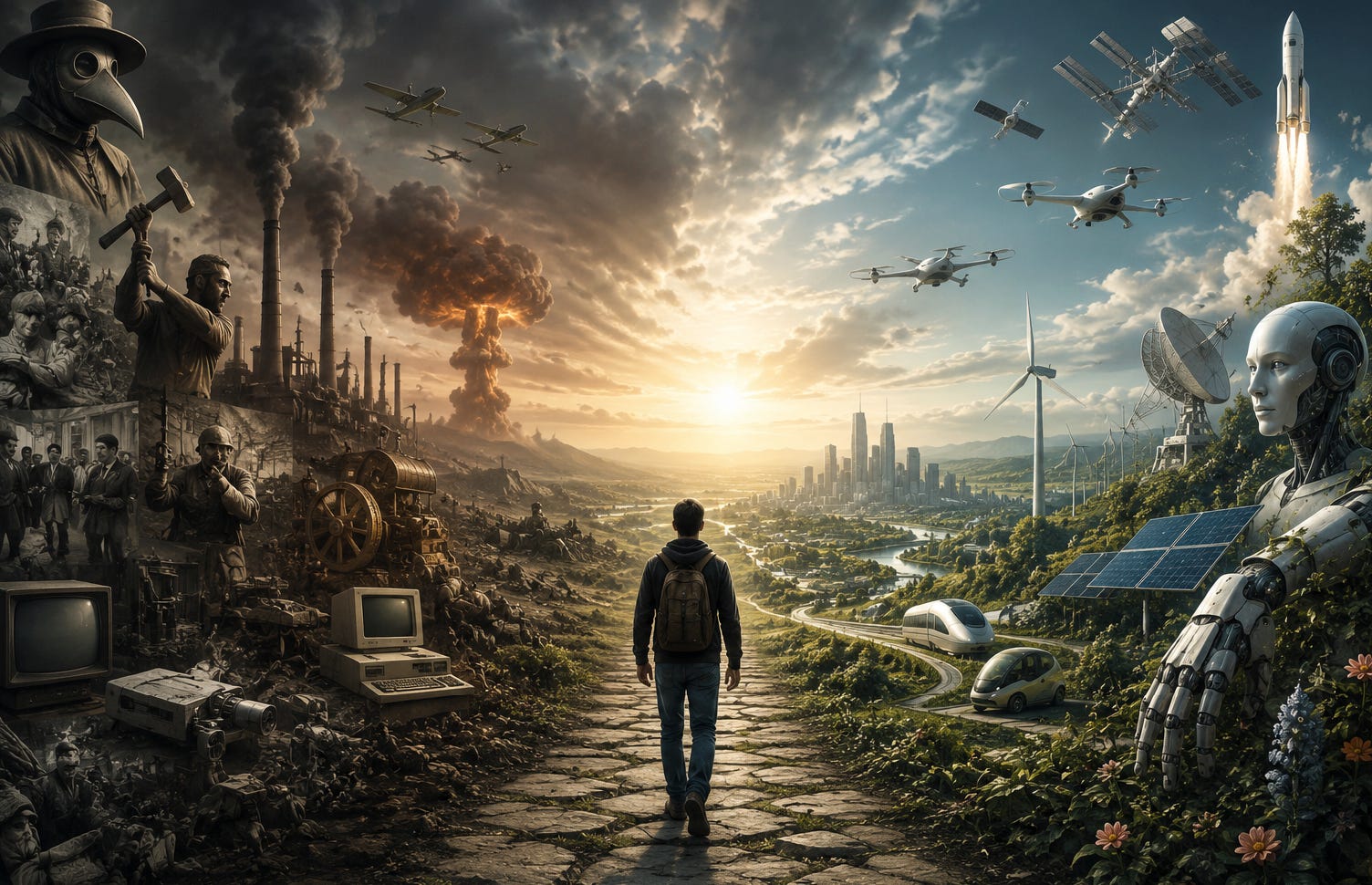
Some people say AI will end humanity by 2050. Others say it will end work within a few years, and with it, how most people feed themselves.
The predictions sound new.
They are not.
We have heard this before
In 1798, Thomas Malthus predicted mass starvation was unavoidable. In the 1950s, experts predicted nuclear energy would make electricity too cheap to meter. In the 1990s, economists predicted the internet would have no greater impact than the fax machine.
The predictors were not stupid.
They just could not see what did not exist yet.
We never predict what does not exist yet
That is the problem with almost every doomsday prediction. It takes what we know today, projects it forward, and assumes nothing new will show up.
Nobody in 2003 predicted that a social network would reshape elections, mental health, journalism, dating, advertising, and how billions of people form opinions.
Social media created enormous value and enormous damage. It connected the world and damaged attention spans at the same time.
But nobody saw it coming because it did not exist yet.
The future is not a straight line from today.
It never has been.
When doomsday predictions become policy
China took the population crisis prediction seriously. Worried about running out of food and resources, the government introduced the one-child policy and enforced it for decades.
It worked.
Now the fertility rate is far below the level needed to maintain the population. Birth rates collapsed. The country that feared it would have too many people now faces a future where it may not have enough.
That is what happens when you plan the future assuming nothing will change. The predicted crisis does not arrive, but the response creates a different one.
And we still make the same mistake today.
We project current life expectancy, current retirement age, current birth rates, and current health conditions forward and call the result inevitable.
But what if the variables change again?
Life expectancy already more than doubled once. Medical progress is accelerating, not slowing down.
The real question is not whether people live longer. It is whether they stay healthy and productive longer.
If medicine extends functional working age by 20 years, everything changes. Retirement, workforce, healthcare, all of it looks completely different.
We are still projecting the future assuming a 70-year-old in 2050 will resemble a 70-year-old today.
That may become the modern version of the Malthus mistake.
Gene therapies, AI-assisted diagnostics, cancer detection years before symptoms appear, drugs targeting biological aging itself, these are already being researched and tested now.
Maybe they fail.
Maybe they work far better than expected.
As always, we do not know what we do not know.
The black swan is never the one you are watching
Humans are very good at predicting the disaster they already recognize.
Then something else arrives.
We built pandemic playbooks after SARS. COVID still caught the world off guard.
I suspect the same thing will happen with AI. We will spend years arguing about one specific apocalypse scenario, while the real transformation comes from somewhere else nobody modeled properly.
That has happened repeatedly throughout history.
Who knows. Maybe while we are busy debating whether AI will destroy us, aliens show up and AI turns out to be the only thing that saves us. Unlikely? Sure. But no less unlikely than most of the things that actually happened.
Or maybe while we are busy regulating AI, a supervolcano erupts or an asteroid hits and none of our debates mattered at all. The dinosaurs did not have carbon emissions or nuclear weapons. They disappeared anyway. Nature does not wait for our permission. But we are still here. At least that time, we made it.
Most major technologies expanded human capability
They also created new risks. That is how technology works.
The printing press spread knowledge and propaganda. Electricity powers hospitals and electric chairs. The internet gave us infinite information and infinite distraction. Nuclear energy powers cities and can destroy them.
But the direction has still been forward.
People lived to about 32 in 1900. Now it is over 73. Not because of one breakthrough, but because of thousands of small ones building on each other. Clean water, vaccines, antibiotics, surgery, sanitation, nutrition.
Nobody looks back at the industrial revolution and says it was the end of humanity.
It was chaotic. Entire industries disappeared. Millions of jobs changed.
But humans adapted.
That pattern matters.
The doomsday argument has a blind spot
The argument usually goes like this: AI becomes more intelligent, more capable, more autonomous, and eventually replaces humans.
Maybe.
But those predictions almost always assume something unrealistic:
That AI evolves while humans remain unchanged.
That has never happened with any major technology.
Humans absorb tools. We adapt around them. We merge with them.
A person using AI is already more productive than a person without it. That gap will grow.
We spend endless time discussing what AI might become in 10 or 20 years. We almost never discuss what humans become when combined with these systems.
The human of 2040 will not be the human of 2024.
People focus on the creation and forget the creator is changing too.
“AI will take all jobs” is an old panic wearing new clothes
Yes, AI will replace some jobs.
Every major technology shift did.
Typing pools disappeared. Travel agents shrank. Elevator operators vanished. Web developers appeared. Digital marketing appeared.
Entire categories of work were destroyed while new ones emerged.
Work changes shape.
That process is painful for some people every single time. But history does not show work disappearing. It shows people finding new work.
And honestly, humans already outsource thinking constantly. To television. To politics. To religion. To social media feeds. To whatever group they belong to.
AI did not invent intellectual laziness.
We already have everything needed to destroy ourselves
This part of the AI discussion is strange to me.
Humanity has had civilization-ending tools for decades.
Nuclear weapons exist. Biological weapons exist. Chemical weapons exist.
The world could become catastrophic tomorrow without AI being involved at all.
The question was never just about the tool.
It was always about the humans holding it.
And despite everything humans are capable of, we are still here.
We are capable of genocide, torture, mass destruction, and cruelty on unimaginable scales. History is full of evidence.
But history is also full of builders.
Doctors. Engineers. Scientists. Farmers. Parents. Teachers. People quietly improving the world generation after generation.
That side has won more often than not. Not perfectly. Not everywhere. But enough for civilization to keep moving forward.
That track record matters when discussing the future.
And personally, I would rather live in a world where my biggest concern is unexpected AI behavior than a world where a bacterial infection kills people because nobody discovered hand washing yet.
I would rather debate AI replacing jobs than live in a world where childbirth routinely kills mothers and children.
Every era has danger.
Ours is not uniquely terrifying.
It is just modern.
I would rather fight the Terminator than go back to the cave and fight the bear.
We do not even understand ourselves
Here is the part that makes confident AI predictions look strange.
The human brain contains roughly 86 billion neurons connected through an estimated 100 trillion synapses. We still do not fully understand how consciousness works, how memory truly forms, or how subjective experience emerges.
A neuroscientist famously bet in 1998 that science would explain consciousness within 25 years.
He lost the bet in 2023.
The most complex known structure in the universe sits between our ears, and we are still trying to understand it.
So when someone confidently says AI will surpass human intelligence by 2050, the obvious question becomes:
Surpass what exactly?
We do not even fully understand the thing being compared against.
And beyond intelligence, humans have something else entirely. Survival instincts. Intuition. Emotional perception. The ability to function under extreme stress in ways that often surprise even medical professionals.
Anyone who worked in emergency medicine, disaster response, or war zones knows you cannot fit a human into a spreadsheet.
AI learned from what we shared, not from everything that exists
AI models learn from human-produced data.
Text we wrote. Images we uploaded. Code we published. Conversations we recorded.
That is still only a fragment of reality.
It does not include decades of living inside a physical body. Pain. Hunger. Aging. Hormones. Fear. Presence. The way an experienced doctor reads a room before looking at test results. The way a parent senses something is wrong before words are spoken.
AI is extremely good at detecting patterns inside the information it has access to.
But we keep comparing that fragment to the full range of human existence as if they are equivalent things.
They are not.
What happens next
Maybe AI reaches AGI. Maybe it becomes autonomous. Maybe it self-improves faster than humans can react.
Maybe.
But there is another side to that equation.
If humans are capable of creating systems that powerful, imagine what those same breakthroughs do for humans themselves.
The same advances that improve AI will likely improve medicine, science, engineering, education, biology, and human capability too.
Again, people focus on the creation while ignoring that the creator is evolving at the same time.
If you want a creation story parallel: God created people, and look how that turned out. The creator does not always control the creation. Or take the other view, evolution. No creator at all. Just a process that moves forward without anyone steering it. Mutations, adaptation, selection. No plan, no permission, no committee deciding what comes next. It just goes. And here we are, the most complex result of that process, now building the next layer on top of it.
Whether you believe in design or evolution, the conclusion is the same. What comes next is not fully in our control. It never was.
We panic every single time
People protested machines during the industrial revolution and literally destroyed equipment because they feared losing work.
Teachers warned calculators would make students stupid.
My math teacher told me 35 years ago that using calculators would destroy our ability to think.
Then came computers. Then the internet. Then smartphones. Now AI.
The kids who used those calculators grew up to build the internet. The kids who grew up on computers created AI. The thing some people now call superior to humans. So did we become stupid, or did we become capable of building something smarter than anything before us?
The pattern is not that humans stay calm.
The pattern is that humans panic, adapt, absorb the tool, and eventually reorganize society around it.
Every single time.
Security matters more than bureaucracy
I agree with people who say AI safety matters.
But safety and regulation are not the same thing.
Regulation often slows innovation, protects incumbents, creates bureaucracy, and punishes smaller builders more than large corporations.
Security is different.
Security means resilient systems. Better safeguards. Better architecture. Better fail-safe mechanisms.
You do not make cars safer by banning them. You make them safer by building better brakes, seatbelts, and roads.
That approach matters much more long term.
The bigger mistake may be underestimating humans
I am not here to tell you everything will be fine by 2050.
Nobody knows that.
But the conversation around AI is still too narrow. Most discussions isolate AI from the humans using it, adapting to it, and evolving alongside it.
History suggests that is a major mistake.
Every generation believed its danger was uniquely catastrophic.
So far, humans survived plague, famine, industrialization, world wars, nuclear weapons, and the internet.
Not because the risks were fake.
Because humans adapted faster than the predictions expected.
The best way to move forward is not to predict or panic. It is to do something useful. Build something. Solve a real problem. Help someone. The people who actually shape the future are never the ones arguing about it online. They are the ones too busy making things.
And let's be honest. Countries have tried to stop progress before. Ban the technology. Close the borders. Control what people can build. It worked for a while, in isolated places. It never worked at scale. And those places are never the ones anyone wants to live in.